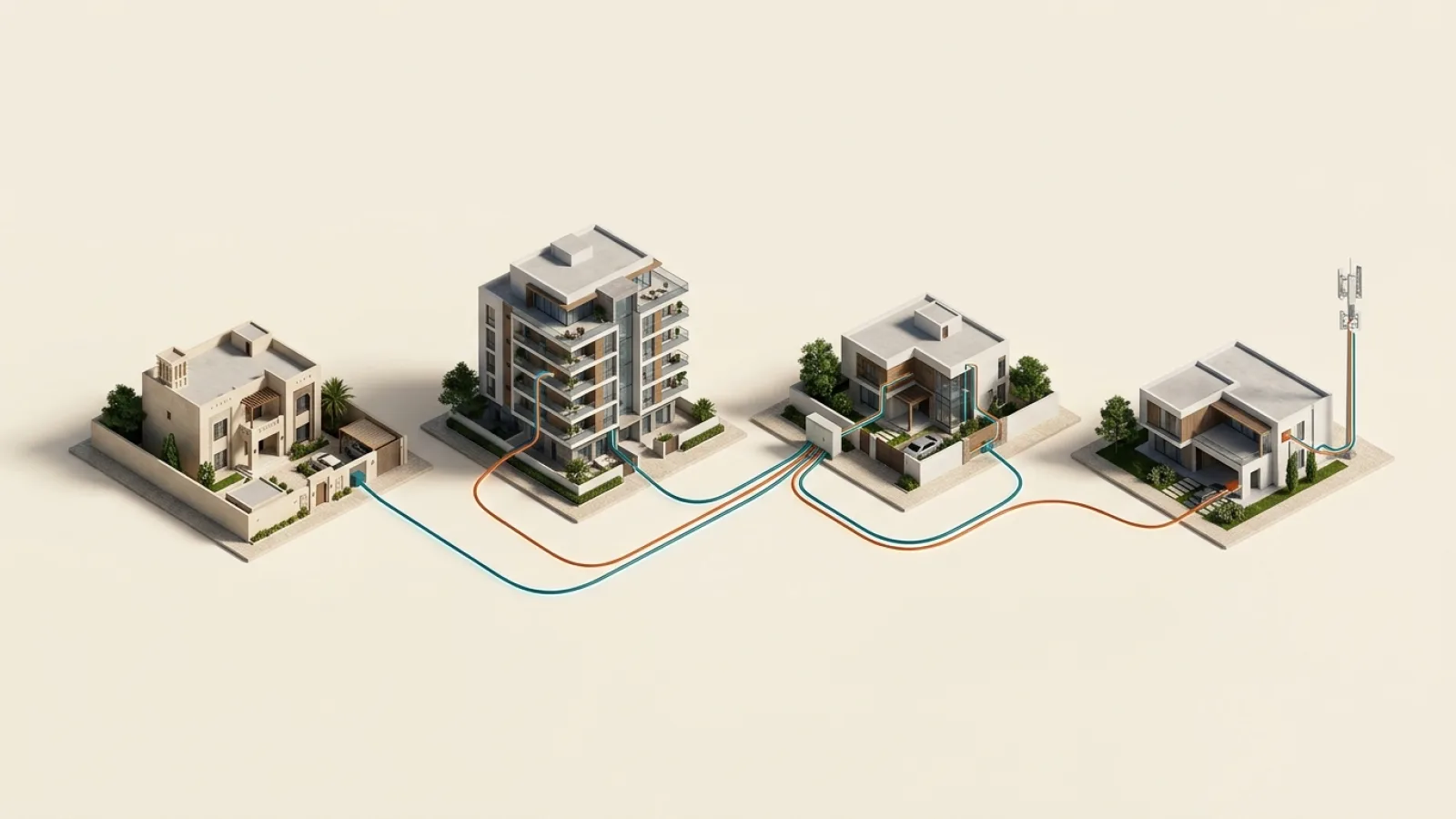

Terms such as FTTH, FTTB and FWA describe how internet reaches your property. As a subscriber, focus on real address availability, plan conditions and household performance.
Compare eligible Zain and Mobily home Fiber and 5G plans with Saryan once you understand the basic difference.
- The Access Network Architecture: Why "The Last Mile" Governs Your Digital Experience
- FTTH (Fiber-to-the-Home): The Gold Standard of Symmetrical Optical Transport
- FTTB (Fiber-to-the-Building): Multi-Dwelling Unit (MDU) Distribution Topologies
- FTTC (Fiber-to-the-Curb): The Legacy Copper Chokepoint
- FWA (Fixed Wireless Access via 5G): Instant High-Capacity Wireless Deployment
- Comprehensive Engineering Comparison Matrix: Access Mediums Evaluated
- Demystifying "Fiber-Powered" Marketing: How to Verify True FTTH Deployment
- Access Network Medium vs Domestic In-Home Wi-Fi: Decoupling Delivery from Distribution
- Foundations of Passive Optical Networks (PON): Zero-Power Optical Splitting
- The Consumer Selection Blueprint: Choosing the Right Medium for Your Saudi Property
1. The Access Network Architecture: Why "The Last Mile" Governs Your Digital Experience #
The modern global telecommunications matrix comprises three discrete tiers:
- The Core Backbone: Continental and submarine optical transmission conduits interlinking major hyperscale data centers (such as Riyadh and Jeddah internet exchange hubs).
- The Metropolitan / Aggregation Network: High-capacity optical rings routing traffic between municipal central exchanges and regional neighborhood distribution centers.
- The Access Network (The Last Mile): The localized physical segment spanning from the neighborhood distribution cabinet to your customer-premises equipment (CPE).
The Bottleneck Law of Physics #
A carrier may operate an ultra-resilient multi-terabit core network, but end-user throughput remains strictly limited by the lowest-capacity physical medium in the transmission chain. If that last mile utilizes decades-old twisted-pair copper wire susceptible to thermal degradation and electromagnetic attenuation, subscribers inevitably experience compressed download rates, severe packet jitter, and frustrating disconnects during video collaboration or competitive online gaming.
2. FTTH (Fiber-to-the-Home): The Gold Standard of Symmetrical Optical Transport #
Fiber-to-the-Home (FTTH) represents the absolute zenith of fixed broadband telecommunications infrastructure, serving as the foundational medium for Fiber Broadband (FTTH):
A. How FTTH Operates #
- An unbroken, dedicated single-mode optical fiber drop cable—housing a 9µm microscopic silica glass core—extends directly from the local street Optical Distribution Frame (ODF) or Fiber Access Terminal (FAT) into your villa or private apartment.
- The optical drop terminates internally inside a wall-mounted fiber rosette, connecting via a low-loss SC/APC patch jumper into your Optical Network Terminal (ONT).
- Physical Transport Medium: Modulated infrared laser light pulses propagating near the speed of light through glass, operating with zero electrical currents and zero metallic conductors along the exterior distribution pathway.
B. Defining Advantages of FTTH: #
- True Gigabit and Multi-Gigabit Capacities: Capable of delivering symmetrical throughput from 300 Mbps to 1,000 Mbps, scaling to 10 Gbps and beyond via XGS-PON architectures.
- Ultra-Low Latency: End-to-end optical transmission achieves pristine baseline latencies between 1 and 4 milliseconds, delivering optimal response times for latency-sensitive applications.
- Total Electromagnetic and Environmental Immunity: Photons traversing optical glass are completely immune to neighboring high-voltage electrical conduits, radio interference, moisture oxidation, and Saudi Arabia's extreme summer temperatures.
3. FTTB (Fiber-to-the-Building): Multi-Dwelling Unit (MDU) Distribution Topologies #
Fiber-to-the-Building (FTTB) is prevalent across high-density residential towers, corporate office parks, and commercial compounds:
A. Architectural Blueprint #
- High-strand optical feeder cables enter the building's central telecommunications demarcation closet, typically stationed in the basement or primary utility intake room.
- Vertical Last-Meter Distribution: From the basement optical frame to individual apartments across upper floors, data transmits via:
- Structured Cat6/Cat6A twisted-pair copper cabling, sustaining gigabit throughput over distances up to 100 meters.
- Legacy building copper using specialized VDSL2 or G.fast transceivers in older architectures where pulling new riser conduits is cost-prohibitive.
B. Engineering Trade-Offs: #
- FTTB reduces building civil retrofit costs, but end-user bandwidth is contingent upon the integrity of internal vertical building wiring. Substandard riser cables or shared electrical chases can introduce packet loss and restrict peak package speeds.
4. FTTC (Fiber-to-the-Curb): The Legacy Copper Chokepoint #
Fiber-to-the-Curb / Cabinet (FTTC) represents an interim architecture widely deployed during the early 2000s:
A. The Mechanical Topology #
- Carriers route optical fiber from the central exchange to a large active roadside cabinet (MSAN) situated at the corner of a residential neighborhood.
- The Copper Bottleneck: Across the remaining 100 to 1,000+ meters between the street cabinet and your living room, transmissions rely on legacy unshielded copper telephone wires (twisted pairs) operating over VDSL protocols.
B. Severe Technical Limitations: #
- Distance-Based Signal Attenuation: High-frequency electrical signals degrade dramatically over copper loops. A home 200 meters from the cabinet might achieve 80 Mbps, while a home 700 meters away struggles to sustain 20 Mbps.
- Crippling Upstream Asymmetry: VDSL frequency profiles heavily favor download bandwidth, capping upstream throughput at a meager 5 to 20 Mbps. This severely constrains cloud backups, high-resolution video broadcasting, and large enterprise file transfers.
- Vulnerability to Weather and Interference: Buried copper telephone lines degrade when exposed to groundwater intrusion, ground shifts, and electromagnetic noise from municipal power infrastructure.
5. FWA (Fixed Wireless Access via 5G): Instant High-Capacity Wireless Deployment #
Fixed Wireless Access (FWA) leverages advanced cellular base stations to deliver high-speed domestic broadband over the airwaves:
A. How FWA Operates #
- Rather than excavating streets to lay physical conduits, broadband data transmits via 5G New Radio (NR) mid-band (C-Band / 3.5 GHz) or millimeter-wave (mmWave) radio sectors from local cellular towers.
- The subscriber deploys a high-gain, dedicated 5G wireless home gateway (CPE) configured with specialized directional antennas pointed toward the serving tower sector.
B. When FWA Represents the Optimal Solution: #
- Newly Developed Districts Awaiting Civil Fiber Infrastructure: FWA bridges the connectivity gap instantly, delivering hundreds of megabits per second without waiting months for municipal fiber trenching projects.
- Mobile and Rented Residences: Provides instant broadband portability across Saudi Arabia by simply updating your registered National Address profile.
- Zero Civil Disruption: Immediate self-installation without technician drilling, conduit pulling, or wall alterations.
6. Comprehensive Engineering Comparison Matrix: Access Mediums Evaluated #
The following matrix contrasts physical, transmission, and operational metrics across all four delivery architectures:
| Evaluation Metric | FTTH (Direct Fiber) | FTTB (Building Fiber) | FTTC (Curbside Fiber) | FWA (5G Wireless) |
|---|---|---|---|---|
| Last-Mile Medium | 100% Optical Glass Core | Internal Cat6 / Copper | Legacy Copper Phone Wire | 5G NR Radio Frequencies |
| Peak Practical Download | 1,000M to 10,000M | 100M to 1,000M | 20M to 100M max | 200M to 800M (sector-dependent) |
| Upstream Throughput | Multi-hundred Mbps / Symmetrical | Moderate to High | Severely capped (5M–20M) | Moderate (30M–100M) |
| Baseline Latency (Ping) | 1 – 4 ms (Unshakeable) | 2 – 8 ms | 15 – 35 ms | 12 – 25 ms |
| Environmental Resilience | 100% Weatherproof & Immune | High to Moderate | Degrades with water/heat | High, minor storm sensitivity |
| Deployment Lead Time | Scheduled field install | Scheduled field install | Scheduled field install | Immediate same-day activation |
7. Demystifying "Fiber-Powered" Marketing: How to Verify True FTTH Deployment #
Telecommunications advertising frequently incorporates ambiguous phrases such as "Fiber-Backed Broadband" to market legacy FTTC services, justifying the claim by pointing to the fiber feeding the roadside cabinet!
How to Authenticate Authentic 100% FTTH at Your Address: #
- Inspect Your Building's External Demarcation Plate (FAT Plate): Locate the metallic or hardened plastic plate on your property's exterior boundary wall. True FTTH infrastructure carries a designated Fiber Access Terminal code (e.g.,
SLM-RYD-042-FAT-12). - Examine Your Gateway Ingress Interface: Authentic FTTH terminates via a single, thin, yellow optical jumper cable with a green or blue optical connector (SC/APC or SC/UPC) plugged directly into your ONT. If your router connects to a standard gray telephone cable with an RJ11 modular clip, your service operates over copper FTTC.
8. Access Network Medium vs Domestic In-Home Wi-Fi: Decoupling Delivery from Distribution #
Subscribers frequently conflate the physical transport bringing broadband into their property with the wireless Wi-Fi signals distributing it internally:
- A property may possess a blistering 1 Gbps FTTH optical connection, but if an occupant connects from an isolated bedroom through two solid reinforced concrete walls, local Wi-Fi signal attenuation may restrict throughput to 35 Mbps. The subscriber mistakenly assumes their optical fiber is underperforming!
- FTTH and FWA govern the bandwidth and stability delivered to your doorstep, whereas internal Cat6 structured cabling, mesh backhauls, and Wi-Fi access points govern how effectively that bandwidth disperses across your living spaces.
9. Foundations of Passive Optical Networks (PON): Zero-Power Optical Splitting #
Modern FTTH broadband architectures are engineered upon Passive Optical Network (PON) standards:
- The designation "Passive" signifies that optical conduits traversing municipal street ducts require zero active electrical power supplies, amplifiers, or regenerative repeaters between the central exchange and your home.
- A single feeder fiber splits into 32, 64, or 128 individual subscriber lines using unpowered optical prism splitters.
- Primary commercial standards include mature GPON (Gigabit PON) and next-generation symmetrical XGS-PON (10-Gigabit Symmetrical PON).
10. The Consumer Selection Blueprint: Choosing the Right Medium for Your Saudi Property #
To make an informed broadband decision:
- If Your Property Has Verified FTTH Coverage: Direct optical fiber remains the uncontested gold standard for ultra-high throughput, gaming latency, remote corporate productivity, and unlimited household streaming.
- If You Reside in a Developing District Awaiting Fiber Deployment: authorized carrier 5G Fixed Wireless Access (FWA) delivers the fastest, most reliable immediate alternative, avoiding civil delays and providing high-speed connectivity from day one.
11. The Evolution of Saudi Access Infrastructure: From Legacy Copper to National Bitstream Open Access #
The telecommunications landscape across the Kingdom of Saudi Arabia has undergone a generational structural transformation over the past decade under the framework of Saudi Vision 2030 and the National Transformation Program. The Kingdom systematically transitioned from aging copper topologies (ADSL and VDSL2) to deploy one of the world’s most advanced, high-density optical fiber networks:
A. The Structural Leap from Copper FTTC to Pure Optical FTTH #
In prior telecommunications epochs, FTTC was the dominant topology across Saudi municipalities. Optical trunks reached neighborhood roadside cabinets, while the final distribution leg relied on unshielded twisted-pair copper wire. This hybrid configuration suffered from severe signal attenuation, electromagnetic interference, and thermal degradation, capping maximum downstream throughput between 20 and 40 Mbps. Through national broadband investment initiatives, pure FTTH optical drops were constructed to over 3.8 million households across Saudi metropolitan regions, shattering legacy speed bottlenecks and enabling standardized domestic offerings spanning 300 Mbps to multi-gigabit symmetric connections.
B. The National Bitstream Open Access Interconnection Mandate #
Among the most progressive regulatory milestones executed by the Communications, Space and Technology Commission (CST) was the formal enactment of the National Bitstream Open Access Framework. Historically, residential subscribers were commercially locked to the specific infrastructure carrier that installed the physical outdoor termination box (FAT) on their perimeter wall. Under the Open Access mandate, infrastructure barriers were dismantled: any Saudi household can select their preferred retail service provider (such as Zain or Mobily) regardless of which operator excavated the roadway or deployed the passive optical splitters. This structural separation between physical asset ownership and retail delivery has accelerated competitive service differentiation, reduced tariffs, and elevated consumer support standards.
C. Extreme Desert Climate Hardening and Infrastructure Resilience #
Physical outside-plant (OSP) fiber cabling deployed across Saudi Arabia must endure some of the planet’s most demanding environmental stress profiles. Ambient summer surface temperatures regularly surpass 50°C, accompanied by intense ultraviolet radiation and corrosive saline atmospheric conditions in coastal hubs such as Jeddah, Dammam, and Al-Khobar. Saudi OSP standards mandate the use of all-dielectric self-supporting (ADSS) and armored underground cables featuring UV-stabilized high-density polyethylene (HDPE) outer sheathing, water-blocking swellable yarns, and thixotropic petroleum jelly compounds that prevent moisture intrusion and micro-particle sand infiltration into subterranean splice closures.
12. Physical Layer Diagnostics and Field Metric Auditing for Last-Mile Integrity #
Confirming that your residential access medium operates at peak physical performance requires monitoring standardized diagnostic metrics specific to the physical layer:
A. Optical Link Budget Auditing in FTTH Networks #
In pure FTTH deployments, circuit performance is determined by optical attenuation measured in decibels relative to one milliwatt (dBm):
- Optimal Optical Reception Range (Rx Optical Power): Standard GPON/XGS-PON optical network terminals (ONTs) operate optimally between -15 dBm and -22 dBm. Within this attenuation envelope, optical transceivers operate with zero bit-error rates.
- Operational Tolerance Threshold: Acceptable link budgets tolerate attenuation up to -25 dBm.
- Optical Degradation Threshold: If optical power falls below -27 dBm (e.g., -29 dBm or -33 dBm), the ONT PON indicator will flicker or glow red, triggering intermittent packet drops and latency spikes. This degradation typically stems from macro-bending along the interior drop jumper, a contaminated SC/APC ferrule interface, or micro-cracks inside the external FAT fusion splice.
- SC/APC Optical Ferrule Hygiene: Microscopic dust contamination on the angled physical contact (APC) 8-degree ferrule tip accounts for over 60% of domestic fiber link degradations. Certified carrier field technicians utilize dry-cloth mechanical click-cleaners to eradicate dust particles before reseating optical jumpers.
B. Radio Frequency Telemetry Auditing in 5G Fixed Wireless Access (FWA) #
When utilizing 5G wireless broadband, the gateway internal administrative console exposes critical RF parameters:
- Reference Signal Received Power (RSRP): Measures received carrier power. Optimal readings range from -70 dBm to -85 dBm; marginal reception spans -95 dBm to -105 dBm.
- Reference Signal Received Quality (RSRQ): Indicates signal quality across resource blocks; values superior to -10 dB represent clean RF reception.
- Signal-to-Interference-plus-Noise Ratio (SINR): The definitive indicator of channel capacity and stability. Values exceeding +15 dB to +25 dB enable the terminal to lock into high-order modulation schemes (256-QAM or 1024-QAM), securing sustained multi-hundred-megabit throughput.
Practical Subscriber Checklist Before Selecting a Zain or Mobily Home Plan (K26) #
When evaluating whether to upgrade your home connectivity or comparing Zain and Mobily Home Fiber and 5G packages through SARYAN, applying a structured household checklist ensures that your chosen subscription matches your real daily workload without unnecessary overspending:
- Audit Peak-Hour Household Concurrency: Count how many 4K smart TVs, remote-work laptops, cloud backup tasks, and gaming consoles run simultaneously between 8:00 PM and 11:00 PM, because concurrent active streams and uploads determine the real bandwidth headroom your family needs.
- Verify Indoor Hardware Placement and Cabling: Even on a high-tier Zain or Mobily Fiber or 5G subscription, central router positioning and direct Cat6 Ethernet wiring for stationary setups (home offices, gaming desks, and main living-room screens) make a decisive difference in latency stability and Wi-Fi consistency.
- Review Total Contract Terms Transparently: Check the monthly tariff, 15% VAT treatment, contract commitment period, and router inclusion terms published for the selected operator package, and confirm address-level coverage before submitting your subscription request.
- Ask a SARYAN Sales Advisor for Direct Comparison: If you want help matching your address coverage and household usage to the right Zain or Mobily Fiber or home 5G package, contact the SARYAN team by phone or WhatsApp for clear, practical pre-order guidance.
Internal links #
/coverage— Verify building FAT plates and National Address broadband availability/compare— Compare residential Fiber Broadband (FTTH) FTTH and 5G Home Broadband plans/knowledge/fiber-vs-5g-home-internet— Comprehensive decision guide: Fiber vs 5G broadband (K01)/knowledge/gpon-vs-xgs-pon-home-users— GPON vs XGS-PON optical network standards (K27)/knowledge/new-home-internet-setup-checklist— New home telecom cabling and conduit design (K24)/support— Contact SARYAN engineering and technical customer support
Editorial source review #
This architectural guide has been authored and verified by SARYAN network infrastructure engineers, adhering to International Telecommunication Union (ITU-T) access network recommendations, Broadband Forum technical reports, and CST telecommunications infrastructure deployment regulations in Saudi Arabia.